How to run an SOP gap audit: what your documentation says versus what your team actually does
The generic version of this method assumes a compliance department and a slide deck. Here's the version that takes an afternoon and a recording.
A fulfillment manager pulls up a recording of how her team packed a rush order last Tuesday. She wants to check one thing: whether people are still following the express-shipping checklist step for step. By minute four she has stopped checking. Nobody in the recording opened the checklist at all.
The SOP says confirm the shipping speed on the order tag before picking. What actually happens is the picker glances at the packing slip color, a shortcut the team built themselves eighteen months ago and never wrote down anywhere. It works. It has worked for eighteen months. It is also not what the document says, and nobody who had only read the document would ever know that.
That gap, the space between what a procedure says and what a team actually does, is close to the default state of any SOP more than a few months old. An audit is how you find it before a customer does.
SOP drift: why your documentation is lying to you
The diagnosis this audit turns into a repeatable habit. That post explains why drift happens. This one is the method for finding it in your own procedures.
Not your compliance team's gap analysis
Search for how to run a gap analysis and most of what comes back is written for a different reader. A QA manager mapping SOPs to regulatory clauses. A project manager comparing a current state to a five-year target. The underlying idea is the same, find the difference between the document and reality, but the method assumes a compliance department and a multi-week engagement.
A DTC ops team does not need that version. It needs something smaller. Something that takes an afternoon, uses a recording or a shadowed shift instead of a scheduled workshop, and produces a short list of specific fixes instead of a slide deck nobody reopens.
The bigger difference is the source of truth. Compliance-style gap analysis usually runs on interviews: someone describes how they do the work, and the description gets compared to the document. Self-reported process and actual process are rarely identical. Not because people lie, but because everyone slightly overstates how closely they follow steps they already know they should be following. An audit built on watching or recording the real task closes that gap. It compares the document to what happened, not to what someone remembers happening.
The five-step audit
This runs the same way for a five-person support team or a fifty-person fulfillment operation. Scale the sample size, not the method.
- Pull five to eight recent, real instances of the task. A screen recording if the work happens on a screen, a shadowed shift if it doesn't. Not a demo run performed for the audit. The actual thing, from this week or last.
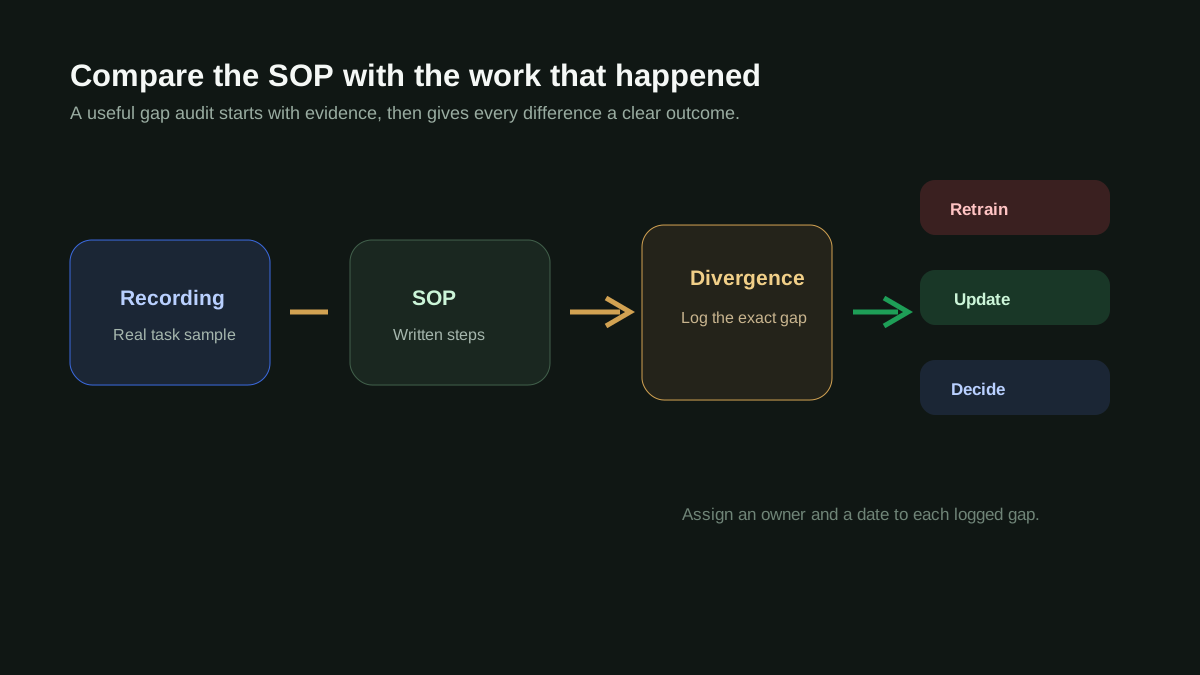
- Open the written SOP next to it and walk both in parallel, step for step. Note every point where they diverge, not only the ones that look like a problem. A harmless shortcut is still a divergence worth logging.
- Sort each divergence into one of three buckets: the SOP is right and the team drifted, the team found something better and the SOP is behind, or the divergence is genuinely ambiguous and someone needs to make a call.
- Write down the specific step, the specific difference, and roughly how long it has likely been happening. "Step 3, team skips it" is not a log entry. "Step 3 says confirm shipping speed on the order tag, team reads the packing slip color instead, consistent across all 6 samples" is.
- Assign one owner and one date per logged gap. A gap without an owner becomes a gap nobody closes, the same failure mode as an SOP without one.
Whose job is it to update outdated documentation?
What step five actually requires. A named owner per gap, not a role, is what turns an audit finding into a fixed document instead of a note nobody acts on.
What a gap looks like, logged
Vague findings do not get fixed. Specific ones do. The difference between a gap log that closes gaps and one that sits ignored is almost always specificity.
| What the SOP says | What the recording shows | Bucket |
|---|---|---|
| Confirm shipping speed on the order tag before picking | Picker reads packing slip color instead, consistent across all samples | Team found a better way. Update the SOP to match. |
| Refunds under $75 approve without escalation | One agent escalates every refund regardless of amount | SOP is right. Retrain, don't rewrite. |
| Verify address against the order confirmation email | Three different approaches across three samples, no consistent method | Genuinely ambiguous. Needs a decision, not just a document update. |
Try it on one of your own procedures.
Record a process once, AI writes the structured SOP. 3 free SOPs, no credit card.
Where to start
Do not try to audit everything in one pass. That produces the same fatigue as trying to document everything in one pass: a burst of effort that finds real problems. Then it never gets repeated, because nobody wants to do it again.
Don't shut down the business to document it: why big-bang SOP projects fail
The same failure mode, one step earlier. A gap audit run as a one-time company-wide sprint tends to die the same way a big-bang documentation project does.
Order by the same logic as choosing what to migrate or what to write first: cost of being wrong. A gap in a refund or chargeback procedure costs a customer or a disputed charge. A gap in an internal handoff checklist costs a few minutes of confusion. Audit the first kind before the second.
Moving SOPs off Google Docs and Slack: what to actually require
The same cost-of-being-wrong ordering, applied to migration instead of auditing. Customer-facing procedures with a dollar figure attached move first in both cases.
Not every gap needs a rewrite
A logged gap has three honest outcomes, and treating all of them the same way, rewrite the document, is how audits produce SOPs nobody trusts.
Sometimes the document was right and the team drifted for a bad reason: a step got skipped under pressure, nobody caught it, and the shortcut became habit. That gets retraining, not a rewrite. Codifying a shortcut that exists because someone was rushed just makes the mistake official.
Sometimes the team drifted because they found something genuinely better, the packing slip color check in the opening example. That gets a rewrite, and fast, because every day the document stays wrong is a day a new hire gets trained on the worse version.
Sometimes the answer is not obvious from the recording alone. Three people verify an address three different ways, and none of them is clearly wrong. That is not a documentation problem yet. It is a decision someone with authority over the process needs to make first, before there is anything correct to write down.
When to run it
A calendar cadence catches drift that has already been sitting for months. A trigger catches it closer to when it started.
Run an audit when a tool changes how a decision gets made, the kind of shift that opens a gap on its own without anyone intending it. Run it after a hiring wave, since new hires either follow the document exactly or invent their own version within the first two weeks, and you want to know which. Run it when a customer complaint reveals that a step exists on paper but nobody actually follows it. Otherwise, run a baseline pass quarterly on your highest-cost procedures. That way the gap never gets a full year to sit unnoticed.
Gorgias AI Agent can now approve refunds from a photo, and your SOP probably doesn't cover it
A concrete version of the first trigger. A vendor ships a feature, a decision starts getting made differently, and the SOP doesn't know yet.
The audit itself takes an afternoon. The habit of running it when something changes, instead of waiting for the next scheduled review, is what actually matters. That habit is what keeps the gap small enough that finding it stays a short exercise instead of a long one.
Frequently asked questions
What is an SOP gap audit?
A gap audit compares your written SOP against a recording or shadowed sample of the real task, step by step, and logs every point where they diverge. Each divergence gets sorted into one of three outcomes: the document is right and the team drifted, the team found a better method and the document is behind, or the situation is genuinely ambiguous and needs a decision before anything gets rewritten.
How do I find the gap between what's documented and what my team actually does?
Pull five to eight recent real instances of the task, a screen recording or a shadowed shift, and walk them in parallel against the written SOP. Log every difference, not just the ones that look like problems, with the specific step, the specific difference, and how consistent it is across samples. Assign one owner and one date to each logged gap so it actually gets closed.
How often should I audit SOPs against actual work?
On a trigger, not a fixed calendar. Run one when a tool changes how a decision gets made, after a hiring wave, and when a customer complaint reveals a step nobody actually follows. Run a quarterly baseline pass on your highest-cost procedures if none of those has happened recently, so a gap never sits unnoticed for a full year.
What should I do when an audit finds a gap between the SOP and actual practice?
It depends on why the gap exists. If the team drifted for a bad reason, a skipped step under pressure that became habit, retrain rather than rewrite, since codifying a shortcut born from being rushed makes the mistake official. If the team found a genuinely better method, rewrite the document quickly, since every day it stays wrong is a day a new hire trains on the worse version. If the right answer isn't obvious from the recording, treat it as a decision to make first, not a document to update yet.
Ready to record your first SOP?
3 free SOPs to start. No credit card required. See if drift detection keeps your docs honest.
Start for freeI built ReccordSOP after watching too many DTC ops teams lose months to undocumented workflows. These SOPs are battle-tested with Shopify operators running $1M to $50M brands.
Last reviewed August 16, 2026
Related reading
SOP drift: why your documentation is lying to you
Most SOPs are wrong within 90 days of publishing. Here's how to detect it before it costs you a customer.
Whose job is it to update outdated documentation?
Most teams answer this with a role, a moment, or a virtue. All three evaporate, which is why the question keeps coming back.
Moving SOPs off Google Docs and Slack: what to actually require
Not a guide to copying files. A checklist for what the next system has to do that the free ones never did.