The shipping cost reduction SOP for DTC brands
Shipping is 10 to 20 percent of your revenue and the carriers raise it every year. Most brands treat it as fixed. It's the most controllable line item you have.
Shipping is one of the largest line items in a DTC P&L, running 10 to 20 percent of revenue for most brands, and it's the one cost that goes up on a schedule. The carriers announce a general rate increase every year, surcharges multiply, and because over 90 percent of DTC orders go to residential addresses, you pay a residential surcharge, commonly $4 to $6, on nearly every package. Left alone, shipping is a quietly rising tax on every order you sell.
Most brands accept it as the cost of doing business, a fixed number they can't do much about. That's the expensive mistake. Shipping is one of the most controllable costs you have, often 25 to 40 percent reducible, and the savings are continuous once you set them up. The reason most brands leave that money on the table isn't laziness; it's that shipping cost isn't one lever, it's a stack of them, and pulling the stack is exactly the kind of multi-step work that never gets done without a documented process.
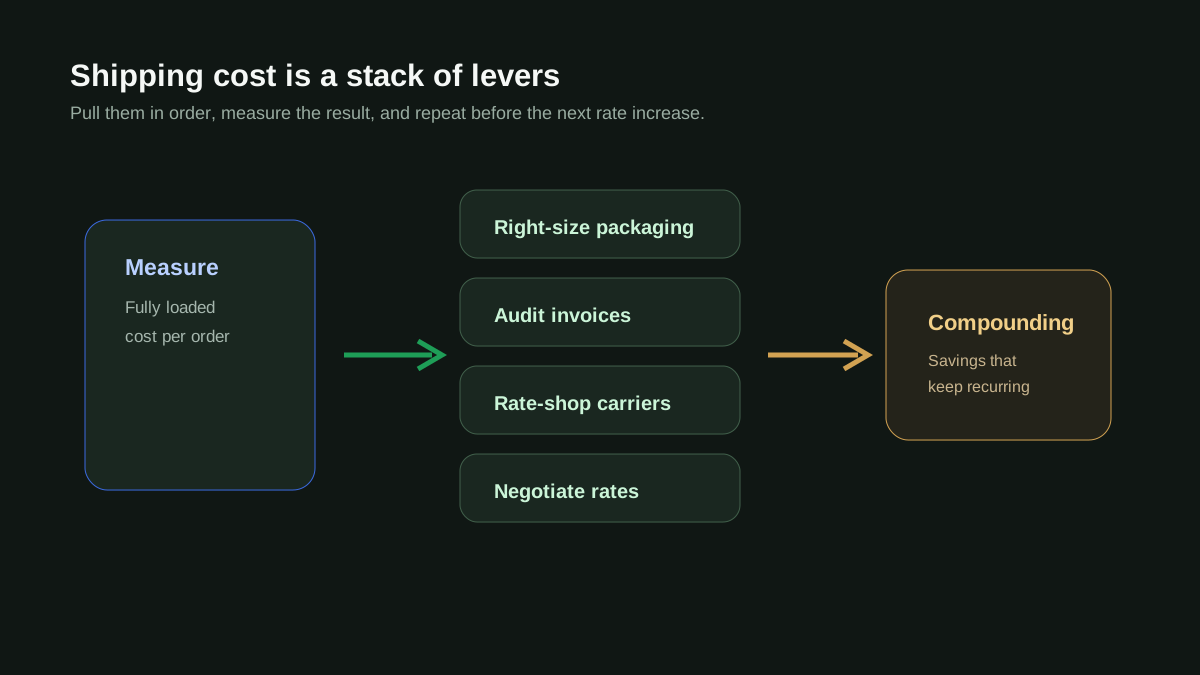
This is that process. The SOP pulls the levers in order of effort-to-payoff: the metric to watch, the packaging fix that's the biggest hidden win, the invoice audit that's free money, the carrier rate-shopping that runs itself, and the negotiation that compounds it all. Each layer stacks on the last, and together they turn shipping from a fixed cost into a managed one.
Shipping cost is not a rate you're stuck with; it's a stack of levers, and most brands pull none of them. Packaging, audits, carrier mix, and negotiation each take a slice off the bill, and they compound. The SOP exists so the whole stack gets pulled, in order, instead of none of it.
Why shipping cost needs an SOP
Shipping savings die in the gap between knowing and doing. Every operator knows they should right-size their boxes or audit their carrier invoices; almost none have a documented routine that makes it happen, so it stays a someday project while the bill climbs. An SOP turns a vague intention into a sequence someone owns and runs.
It also makes the savings durable. A one-time negotiation or packaging change saves money until the next rate hike or new SKU quietly erodes it. Documented, with a review cadence, the optimization stays in place instead of decaying back to the carrier's default, which is the difference between a project that saved money once and a process that keeps saving it.
Start with cost per order
You can't manage shipping cost without measuring it, and the number that matters is fully-loaded cost per order: what it actually costs you to get one package to one customer, including the base rate, surcharges, packaging materials, and dimensional weight penalties. Most brands only know their average and are surprised when they break it down:
- Calculate true cost per order, not just the carrier's base rate. The surcharges and DIM penalties are where the cost hides, and they don't show up until you add them.
- Segment it. Cost per order by product, by carrier, and by zone reveals where the bleeding is, usually a few heavy or bulky SKUs and the long-zone coast-to-coast shipments.
- Set it as the metric you're driving down. Every lever below should show up as a lower cost per order, which is how you know the work is paying off.
This number is the scoreboard for the whole SOP. Without it, shipping optimization is a feeling; with it, every change either moves the number or it doesn't.
Right-size your packaging
The biggest hidden shipping cost for most DTC brands isn't the rate, it's the box. Carriers bill on dimensional weight, the space a package takes up, not just what it weighs, and a parcel that's light but bulky gets billed by its size. For lightweight products in oversized boxes, DIM weight can inflate the cost by anywhere from 40 to 200 percent over what the actual weight would cost. Packaging is where the fastest, biggest savings usually live:
- Right-size the box to the product. Every inch of empty space is billable air. Custom-fit boxes or a tighter set of box sizes cuts the dimensional weight directly.
- Cut the void fill. A smaller box needs less packing material, which saves on both the materials and the DIM weight at once.
- Reconsider the material. A thinner flute, or a poly mailer instead of a box where the product allows, drops both the actual weight and the dimensions.
Run the math on your highest-volume SKUs first, because a packaging change applies to every future shipment of that product. Right-sizing the box on your bestseller is a saving that compounds across every order you'll ever ship of it.
Audit your invoices and claim the refunds
Carriers make mistakes, and the mistakes are almost always in their favor. Roughly 5 to 10 percent of carrier invoices contain billing errors: duplicate charges, wrong zone classifications, surcharges that shouldn't apply. On top of that, carriers owe you refunds for service failures, late deliveries, lost or damaged packages, that they will not pay unless you claim them. This is the closest thing to free money in your operation:
- Audit every invoice for errors. Duplicate charges, incorrect dimensions, misapplied surcharges, and address-correction fees on good addresses are all common and all recoverable.
- Claim refunds for service failures. A late delivery against the guaranteed window is a refund you're owed; most go unclaimed because nobody files them. There are more than fifty types of recoverable failure.
- Automate it. Parcel-audit software does this continuously with no manual effort, and the recovery typically runs 2 to 5 percent of your annual shipping spend, money that was already yours.
The scale of this is genuinely large: well over $2 billion in eligible UPS and FedEx refunds goes unclaimed every year. A brand auditing its invoices is just collecting what it's already owed, at near-zero ongoing effort once it's set up.
Try it on one of your own procedures.
Record a process once, AI writes the structured SOP. 3 free SOPs, no credit card.
Rate-shop across multiple carriers
Most brands ship everything with one carrier out of habit, and pay for the convenience. No single carrier is cheapest for every package; the best rate depends on the weight, the dimensions, and the destination zone. Connecting more than one carrier and letting software pick the cheapest per order is one of the highest-leverage changes available, worth 15 to 25 percent for many brands with essentially no ongoing work:
- Connect at least three carriers, commonly UPS, FedEx, and USPS, plus a regional carrier if it serves your lanes, so there's a real choice per package.
- Let multi-carrier software rate-shop every order automatically. The upfront setup is the work; after that, each package routes to its cheapest qualifying service with no human decision.
- Use regional carriers where they win. A regional carrier often beats the nationals on metro routes, and the software can assign it for those zones while the nationals handle the rest.
ShipStation SOPs
Connect multiple carriers and rate-shop every order automatically; the setup is where the savings come from.
At higher volume, the next level is zone skipping: consolidating packages headed to the same region, trucking them in bulk to a hub near the destination, and paying only local rates for the final mile. It saves $3 to $7 per parcel on long-zone lanes and up to 30 percent overall, but it's a larger operational change, so it belongs in the SOP as the move you graduate into once the simpler layers are running.
One caution as you optimize: the cheapest service is often the slowest, and slow delivery is its own cost. A package that saves a dollar but arrives three days later generates a where-is-my-order ticket that costs more than the dollar. Balance cost against the delivery experience rather than chasing the lowest rate blindly.
The WISMO reduction SOP
Cheaper, slower shipping drives where-is-my-order tickets; weigh the cost savings against the support volume they create.
Negotiate your rates and your DIM divisor
Once you know your cost per order and your package profiles, you have what you need to negotiate, and carrier rates are far more negotiable than most brands assume. The leverage is your volume and your data: you know your lanes, your weights, and what a competitor would charge, and that's what gets a better contract:
- Negotiate the base discount with volume. Even a modest, consistent volume is worth a discount, and carriers expect to be asked; the published rate is a starting point, not a fixed price.
- Negotiate your DIM divisor, not just the rate. The divisor sets how dimensional weight is calculated, and raising it lowers the billable weight on every bulky package. One brand moving its divisor from 139 to 166 cut the DIM impact on most of its packages and saved roughly $180,000 a year.
- Bring competitive bids. The fastest way to a better rate is a real quote from another carrier. Carriers discount to keep volume, and a credible alternative is your strongest lever.
Negotiation compounds everything above it: a better base rate and a higher divisor apply to every package after you've already cut the weight and audited the bill. It's the layer that turns a series of one-time fixes into a structurally lower cost base.
Shopify shipping rates explained, and why they drift
The other side of the gap: what customers are charged at checkout, and the stored values that quietly change it.
Own it, and keep the SOP current
Shipping optimization decays. The carriers raise rates every year and add surcharges, your product mix changes and a new SKU ships in the wrong box, you switch 3PLs and inherit their default rates, a negotiated discount lapses. Any of these quietly walks your cost per order back up, and because it happens gradually, nobody notices until the margin is gone.
The 3PL onboarding SOP
Lock in shipping terms and rate transparency when you onboard a 3PL, before their defaults become your cost base.
Give the SOP an owner, usually ops or finance, and a cadence. Review cost per order monthly as the tripwire, re-check packaging whenever you launch a product, and renegotiate carrier contracts on a schedule rather than waiting for the annual increase to hit. This is the same documentation drift that degrades every operational doc, and on shipping it shows up as the savings you worked for quietly leaking back to the carrier.
SOP drift: why your documentation is lying to you
Why every operational doc, including this one, degrades within 90 days unless you catch it.
Where to start this week
Don't pull every lever at once. Do the two with the best payoff-to-effort first. Calculate your true cost per order, including surcharges and DIM, so you have a baseline and can see where the cost actually hides. Then turn on an automated parcel audit, because it recovers money you're already owed with essentially no ongoing work, and it funds the rest of the project on its own.
From there, right-size the boxes on your top few SKUs and connect a second and third carrier so every order rate-shops. Those layers stack, and each one shows up as a lower cost per order on the scoreboard you started with.
ReccordSOP turns a process like this into a documented SOP with timestamped screenshots, and flags drift when your rates, products, or carriers change underneath it. Generate your first SOP free at reccordsop.com.
Frequently asked questions
How much can a DTC brand realistically cut shipping costs?
25 to 40 percent is achievable by stacking the levers: right-sizing packaging, auditing invoices, rate-shopping across carriers, and negotiating contracts. No single change gets you there, but they compound. Shipping runs 10 to 20 percent of revenue for most DTC brands, so a 30 percent cut is a meaningful margin gain.
What is dimensional weight and why does it matter?
Dimensional (DIM) weight is how carriers price by the space a package occupies, not just its actual weight. A light product in an oversized box gets billed by its size, which can inflate the cost 40 to 200 percent over the actual-weight rate. Right-sizing your packaging is usually the single biggest shipping saving available.
Is parcel auditing worth it?
Almost always. Around 5 to 10 percent of carrier invoices have billing errors in the carrier's favor, and carriers owe refunds for service failures like late deliveries that they won't pay unless you claim them. Automated audit software recovers 2 to 5 percent of your annual shipping spend with no ongoing effort, and over $2 billion in eligible UPS and FedEx refunds goes unclaimed every year.
Should I use more than one carrier?
Yes. No single carrier is cheapest for every package; the best rate depends on weight, size, and destination zone. Connecting three or more carriers and letting multi-carrier software rate-shop each order is worth 15 to 25 percent for many brands, with the setup being the only real work.
Can I actually negotiate carrier rates?
Yes, more than most brands assume. Carriers expect to be asked, and the published rate is a starting point. Use your volume and your shipping data, and bring a competitive bid from another carrier. Negotiate the DIM divisor as well as the base rate, because a higher divisor lowers the billable weight on every bulky package.
Ready to record your first SOP?
3 free SOPs to start. No credit card required. See if drift detection keeps your docs honest.
Start for freeI built ReccordSOP after watching too many DTC ops teams lose months to undocumented workflows. These SOPs are battle-tested with Shopify operators running $1M to $50M brands.
Last reviewed September 29, 2026
Related reading
The 3PL onboarding SOP: a brand-side playbook with an SLA scorecard
Most onboarding guides are written by 3PLs for their own benefit. This is the merchant's playbook, and the scorecard that holds any partner accountable.
The WISMO reduction SOP: cut your biggest support ticket category
WISMO is 30 to 50 percent of your tickets, and most of it is preventable. The customer isn't angry about shipping; they're anxious because you went quiet.
SOP drift: why your documentation is lying to you
Most SOPs are wrong within 90 days of publishing. Here's how to detect it before it costs you a customer.